
Dr Weigang Yao (De Montfort University) reveals the science and collaboration behind the UK-France SMARTFLOW partnership, a project transforming everyday motion into clean and sustainable energy. The project is part of our UK-France Science, Innovation and Technology Researcher Mobility Scheme, funded by the Department for Science and Technology's International Science Partnerships Fund (ISPF).
Fluid motion is everywhere: wind, river currents, ocean waves, and even the gentle swaying of vegetation in a breeze. What if we could convert that ever-present motion into clean, sustainable energy? This question lies at the heart of SMARTFLOW, our UK–France collaboration between De Montfort University (DMU) and the GREMAN Laboratory at INSA Blois.
Supported by the UUKi UK–France Science, Innovation and Technology Researcher Mobility Scheme, our researchers have been working across borders to combine advanced piezoelectric materials with fluid-structure interaction (FSI) modelling and AI-driven optimisation. The goal is simple but ambitious: to design small, efficient, lead-free devices that harvest energy from flowing fluids and vibrations, powering autonomous sensors without batteries or maintenance.
Over the past year, three DMU researchers, Dr Weigang Yao, Dr Meisam Abdi, and PhD researcher Madhav Kafle, have travelled to France to strengthen this partnership. Their experiences offer a window into the scientific progress as well as the human side of international collaboration.
Why this research matters
Many environmental monitoring systems rely on batteries that must be replaced regularly, often in remote or delicate ecosystems. By contrast, fluid-driven energy harvesters can operate continuously using only natural motion. Working with lead-free piezoelectric materials is especially important as Europe is moving toward stricter sustainability regulations. GREMAN is a world leader in developing these environmentally responsible alternatives, while DMU brings expertise in FSI modelling and AI-based design. Together, the teams are developing prototypes that are efficient, resilient, and scalable.
A unique partnership across borders
What makes this project exciting is the genuinely complementary expertise of our two teams.
- At DMU, my group develops computational tools and AI-driven models that predict how structures behave when interacting with flowing fluids.
- At GREMAN, researchers are leaders in the design and fabrication of lead-free piezoelectric materials, an area becoming increasingly urgent as environmental regulations begin restricting traditional lead-based ceramics.
Bringing these strengths together allows us to design energy harvesters that are not only efficient, but also sustainable and scalable. Reflecting on the partnership, Dr Weigang Yao, the principal investigator (PI), emphasised how the mobility scheme is helping build a wider international initiative for clean energy harvesting. In his words, the project is ‘creating a shared platform where expertise in simulation, piezoelectric materials and adaptive design converges into a long-term UK–France collaboration on sustainable energy technologies.’ At a recent meeting in Blois, our teams were able to discuss prototype development and next steps in person.
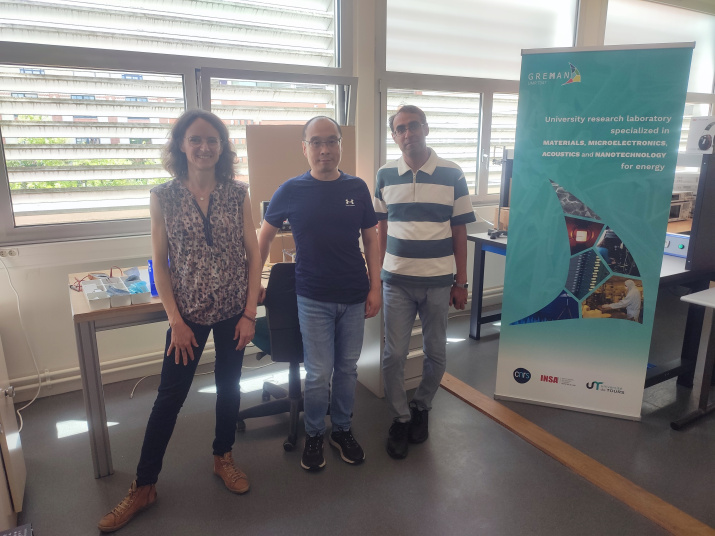
Research team members from GREMAN and DMU, from left to right: Prof. Guylaine Poulin-Vittrant, Dr Weigang Yao, and Dr Meisam Abdi, during a key meeting of the SMARTFLOW UK–France collaboration.
Scientific progress and shared learning
A central focus of our collaboration has been exploring how fluid-driven energy harvesters can become adaptive or, in our words, SMART. Natural flows rarely stay constant, so we have been working together to understand how a device might sense changing conditions and adjust its behaviour automatically.
Much of this work has centred on the piezo-grass concept: flexible, grass-like blades that sway in the flow and convert motion into electricity. By combining DMU’s fluid–structure interaction simulations with GREMAN’s experimental testing, we have begun to map how these structures respond to shifting wind and water patterns, and how their geometry might be tuned to maximise energy output. The piezo-grass concept and early prototype testing have been supported by experiments using vibration-based setups such as the one shown in the image below.
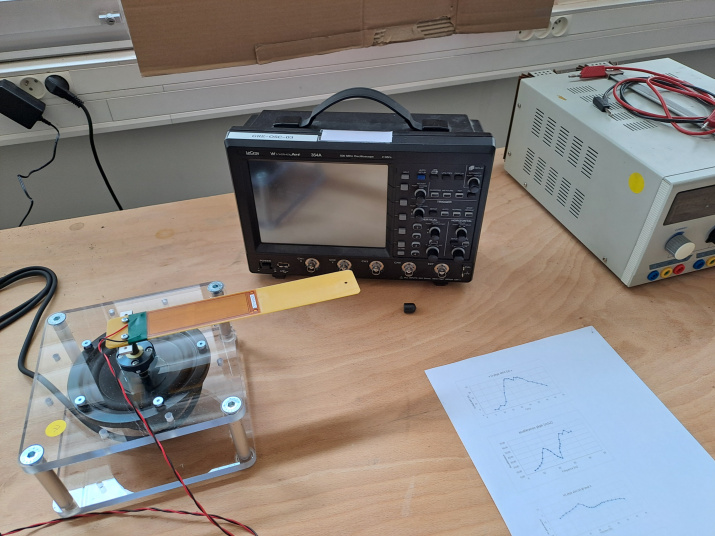
Piezoelectric beam test setup at GREMAN, where controlled vibrations are applied using a shaker to evaluate the device’s energy-harvesting performance.
At the same time, GREMAN’s expertise in lead-free piezoelectric materials has helped us investigate sustainable alternatives for these harvesters. Working alongside their materials team has given us a deeper understanding of how these ceramics perform under dynamic flow and how they can be integrated into lightweight prototypes. Through this shared work, simulation, experimentation, and materials development, we are laying the foundations for next-generation adaptive energy harvesters that are responsive, efficient, and environmentally responsible.
During his four-month placement, PhD researcher Madhav contributed directly to this effort by running fluid–structure interaction simulations alongside GREMAN’s experiments, which he described as giving him ‘a proper understanding of how piezoelectric coupling, material coefficients and the Honami effect relate to each other.’ In parallel, Dr Meisam Abdi’s month-long visit offered hands-on exposure to ceramic fabrication, polarisation and characterisation, which he highlighted as ‘a valuable opportunity to see how lead-free piezoelectric materials are developed and applied as sensors, actuators and energy-harvesting components.’
Impact beyond the laboratory
The technologies we are developing, flexible, adaptive, and lead-free energy harvesters, have the potential to support a new generation of self-powered environmental sensors. These devices are essential for monitoring rivers, coastlines, forests and agricultural land, yet many still depend on batteries that are difficult to replace and create waste.
By designing harvesters that can operate continuously in changing natural flows, we are helping to reduce dependence on disposable batteries and enabling long-term, low-maintenance monitoring of the environments we depend on. This supports wider sustainability goals, including reducing electronic waste and improving the resilience of environmental data networks.
The project also has broader societal and scientific benefits. Our collaboration helps train researchers who can work across materials science, simulation, and renewable energy engineering, skills that are increasingly important as the UK and France move toward ambitious net-zero targets. The strong ties formed between DMU and GREMAN are already leading to new research ideas, shared infrastructure, and the early development of future European funding proposals.
Looking ahead
The progress made during this mobility scheme marks only the start of a longer journey. Our next steps include developing the first SMARTFLOW prototypes, strengthening the integration of lead-free materials with improved simulations, and incorporating early AI-based optimisation tools to make the harvesters more adaptive in real environments. Equally important is the partnership itself. The mobility placements have created lasting links between DMU and GREMAN, opening opportunities for joint publications, shared training, and future European funding proposals.
As we move forward, our aim is to build this collaboration into a sustained UK–France research network that supports early-career researchers and drives innovation in sustainable energy technologies. The foundations are now in place, and we are excited for the next phase of this work.
UK–France Science, Innovation and Technology Researcher Mobility Scheme projects are funded by the Department for Science and Technology's International Science Partnerships Fund (ISPF).