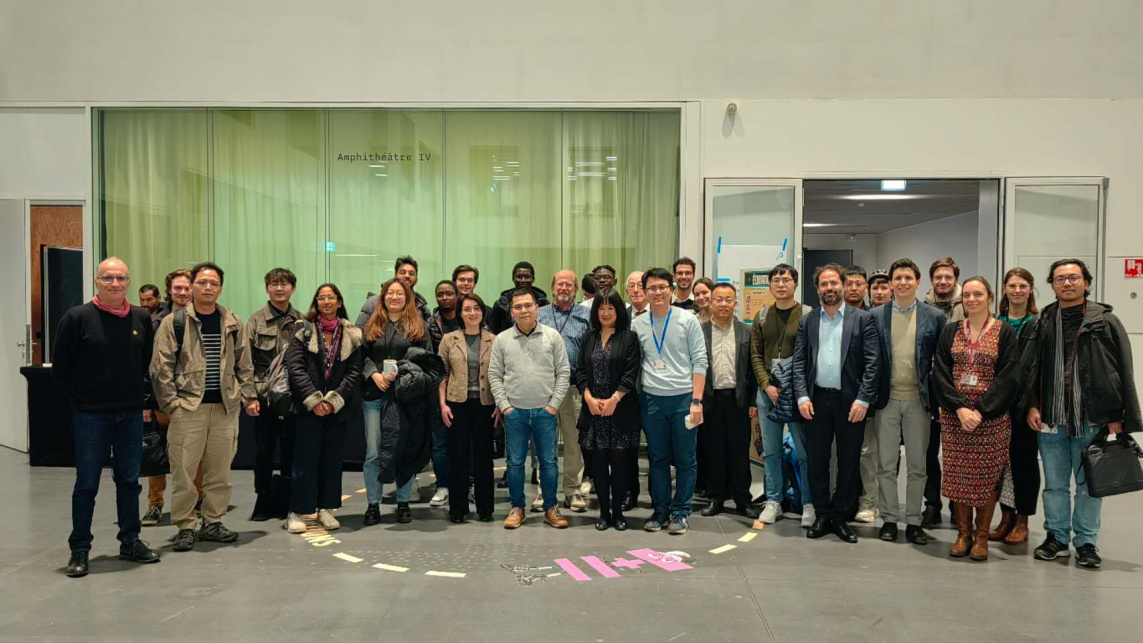
Bin Liu and Yingying Zhao (University of Strathclyde) discuss how a UK–France research collaboration is putting humans back at the centre of AI development to improve the explainability, reliability and safety of systems used in high-stakes decisions.
Artificial intelligence (AI) is increasingly embedded in decisions that matter, from infrastructure and energy systems to healthcare and public services. Yet as AI systems become more powerful, questions around explainability, reliability, and safety are becoming harder to ignore. Our collaborative project, Human-in-the-loop to improve AI explainability, reliability and safety, was born from this shared concern, and from a belief that international collaboration is essential to addressing it.
Funded through the UUKi UK–France Science, Innovation and Technology Researcher Mobility Scheme, the project brings together researchers from the University of Strathclyde and the University of Paris–Saclay. Its core idea is simple but important: AI systems should not operate as opaque black boxes. Instead, human expertise should be actively integrated into the design, evaluation, and use of AI, particularly in high-risk or complex decision-making contexts.
Why human-in-the-loop matters
Much recent progress in AI has focused on improving predictive accuracy. However, accuracy alone is not enough. In real-world applications, decision-makers need to understand why a system produces a given output, when it may fail, and how its behaviour changes under uncertainty. Human-in-the-loop approaches place people directly into the AI lifecycle, not as passive users, but as active contributors who can interpret results, provide feedback, and shape system behaviour.
Our collaboration explores how human input can improve AI explainability, enhance robustness, and reduce safety risks. While the technical work is ongoing, what has already been most valuable is the shared perspective that emerged through sustained researcher mobility and face-to-face engagement.
Building collaboration through mobility
We visited the University of Paris–Saclay during the summer and again in the winter, spending time with colleagues across AI, systems engineering, and decision science. These visits were not just about presenting results, but about building a common language around interdisciplinary research.
Conversations ranged from how engineers interpret model uncertainty, to how social scientists think about trust and accountability in automated systems. Having multiple team members engage in person helped move the project beyond individual exchanges to a shared research culture. Informal discussions over coffee were often as productive as formal meetings, allowing us to surface assumptions that are easy to miss when working remotely.
These visits also highlighted differences in research practice between the UK and France, particularly in how human factors and AI safety are framed. Rather than being a barrier, these differences became a source of learning, prompting us to rethink our own approaches and assumptions.
What we have learned so far
One of the most important lessons from this collaboration is that explainability is not a single technical feature. It is a process that depends on context, users, and purpose. What counts as a ‘good explanation’ for an engineer may be very different from what a policymaker or operator needs. Human-in-the-loop approaches provide a structured way to navigate these differences by keeping people involved throughout system development and deployment.
We have also learned that capacity building works best when it is reciprocal. The Strathclyde team benefited from Paris–Saclay’s strengths in AI theory and system modelling, while our French colleagues engaged closely with applied perspectives on risk, governance, and real-world deployment. This mutual exchange has shaped joint research questions and early co-authored outputs.
Looking ahead
The project has laid the groundwork for longer-term collaboration between our institutions. Future plans include joint publications, co-supervised doctoral research, and expanded mobility involving early-career researchers. Importantly, the partnership has also helped us think more strategically about how human-centred AI research can inform policy and practice, not just academic debate. Based on this mobility grant, we aim to put a bid for the Horizon project “EU Frontier AI Initiative: Developing frontier AI solutions that are safe and computationally efficient within Apply AI (RIA)”.
At a time when AI development often feels fast-paced and fragmented, this UK–France collaboration demonstrates the value of slowing down, working across borders, and putting people back at the centre of technological innovation. Funding from the Researcher Mobility scheme played a crucial role in making this possible, turning what could have been a short-term exchange into a meaningful, trust-based partnership.
As AI continues to shape critical decisions, building systems that are explainable, reliable, and safe will require not only technical advances, but sustained international collaboration and human insight. This project is a small but important step in that direction.
UK–France Science, Innovation and Technology Researcher Mobility Scheme projects are funded by the Department for Science and Technology's International Science Partnerships Fund (ISPF).
Get monthly updates of our work, events, and higher education news