
Skip to main navigation Skip to main content
Home
  • About us
    • Introducing UUK
    • Our members
    • Careers
      • Vacancies
      • What it's like to work at UUK
      • An inclusive, diverse place to work
    • Our history
    • People
    • Governance, annual reports and accounts
      • Articles of Association
      • Our Board
      • Membership criteria
      • Annual reports and accounts
    • Who we work with
    • Our home: Woburn House
  • Topics
    • Teaching, learning and quality
      • Quality and standards
      • Regulation
      • Ways of learning
      • Working with employers
      • Freedom of speech
    • Funding, finance and operations
      • Security and risk
      • Transformation and efficiency
      • University funding
      • Pensions
    • Impact of universities
      • Communities and social responsibility
      • Discoveries, inventions and global challenges
      • Skills and economy
      • Transforming people’s lives
    • Research and innovation
      • Innovation and big ideas
      • Knowledge exchange
      • Research and funding
      • Research standards, ethics and culture
    • Health and wellbeing
      • Mental health
      • Suicide prevention
    • Equality, diversity and inclusion
      • Improving social mobility
      • Opportunities after graduation
      • Safe and inclusive campuses
      • Student success
    • Students
      • Admissions
      • Student finance
      • Student support
      • Student voices and experiences
    • Climate and sustainability
    • International
      • International experience and mobility
      • International research collaboration
      • International staff and students
      • Ukraine
  • What we do
    • Policy and research
      • Policy: an overview
      • Publications
      • Policy & Research team
    • Supporting our members
      • What we do for our members
      • Member benefits
      • Supporting vice-chancellors
      • Events
        • Speak at our events
        • Sponsorship Opportunities
        • Events team
      • Members' meetings and conference
      • Partnership with Studiosity
      • Specialist Institutions Forum
      • Strategy, insight and member engagement team
    • Creating a voice for our members
      • An overview
      • Campaigns
        • Unlock potential with contextual admissions
          • Introduction
          • How to get involved?
        • Industrial strategy
          • Introduction
          • Supporting evidence
          • Advanced manufacturing
          • Clean energy industries
          • Creative industries
          • Defence
          • Digital and technologies
          • Financial services
          • Life sciences
          • Professional and business services
        • Access to success
          • Our action plan for opportunity: making the difference for students  
          • Unlock potential with contextual admissions
          • Collaborate in local cold spots to raise aspirations
          • Set up all students for success with an adequate maintenance package
          • Create career-ready graduates with targeted careers services
        • Unis start up the UK
          • How do universities support start-ups?
          • What impact do start-ups have?
          • What’s the future of university start-ups?
          • Case studies: Enhancing educational outcomes
          • Case studies: Harnessing the tech revolution
          • Case studies: Improving everyday life
          • Case studies: Powering the energy transition
          • Case studies: Promoting sustainable solutions
          • Case studies: Supporting a healthier nation
        • #WeAreInternational
          • The campaign
          • Campaign resources
          • #WeAreInternational student stories
          • #WeAreInternational: Transforming Lives part 2
        • #TwinForHope
          • The campaign
          • Background
          • Our impact
        • Our past campaigns
          • 100 faces
          • Powering the NHS
            • Five-point plan for healthcare education and training
            • Survey of young people's attitudes to NHS careers
          • Getting Results
          • Made At Uni
          • We Are Together
      • Media releases
      • Media team
      • Communications team
    • International
    • Work in parliament
      • Political affairs: an overview
      • All-Party Parliamentary University Group
      • Parliamentary briefings and submissions
      • Political Affairs Network
  • Latest
    • News
    • Events
      • Past events
    • Insights and analysis
    • Newsletter
    • Podcasts
    • Publications
  • Media
  • Events
  • International

Search

  • - Any -
  • Covid
  • Equality, diversity and inclusion
  • Funding, finance and operations
  • Health and wellbeing
  • Impact of universities
  • International
  • Research and innovation
  • Students
  • Sustainability and climate
  • Teaching, learning and quality
  • - Any -
  • UUKi Blog
  • UUKi Insights
  • Insights and analysis
  • Media releases
  • News
  • Publications
  • UUKi Publications
  • UUKi News
  • - Any -
  • Campaign
  • Event
  • Basic page
  • Profile
  • Newest first
  • Oldest first
  • A -> Z
  • Z -> A
  • Relevance

Or browse by topic

  • Teaching, learning and quality
  • Funding, finance and operations
  • Impact of universities
  • Research and innovation
  • Health and wellbeing
  • Equality, diversity and inclusion
  • Students
  • Climate and sustainability
  • International

Breadcrumb

  1. Home
  2. What we do
  3. Creating a voice for our members
  4. Campaigns
  5. Industrial strategy

Defence

The Defence sector covers activities that directly support the production and delivery of goods or services (including subcontracted work) for a defence customer (UK or international).

Case studies

Supporting the Royal Navy’s Dreadnought Programme and Cyber Security, University of Plymouth
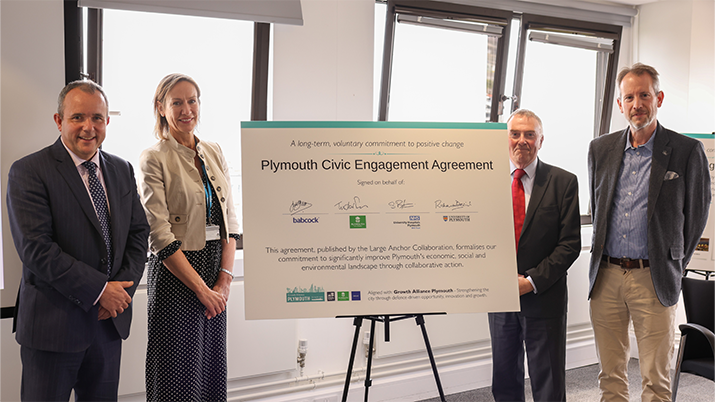
CEA signing with the University of Plymouth for the Royal Navy Dreadnought Programme. The four individuals stand on either side of a large agreement.

The University of Plymouth signing the Royal Navy Dreadnought Programme agreement

The University of Plymouth plays a pivotal role in strengthening the UK’s defence capabilities through strategic partnerships, cutting-edge research and specialised education. Its longstanding collaboration with HM Naval Base Devonport—the largest naval dockyard in Western Europe—has positioned the University as a key contributor to the delivery of the nation’s nuclear deterrent. Working closely with Babcock and Nuclear South West, the University has co-developed programmes in nuclear skills, project management and logistics, equipping staff to manage complex, multi-decade defence projects. Its expertise in shipping, port logistics, research, specialist training and supply chain optimisation directly supports the Dreadnought submarine programme.
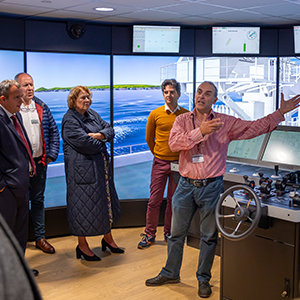
Plymouth University in a cyber security meeting. One individual is speaking to a crowd inside the Cyber-SHIP lab.
The University of Plymouth meeting inside the Cyber-SHIP Lab

Cyber security is another area where the University leads nationally and globally. The Cyber-SHIP Lab, the world’s first maritime cyber-physical testbed, enables real-world testing of vulnerabilities in shipping and offshore systems. This work addresses Tier 1 national security threats and has led to innovations such as the Maritime Cyber Risk Assessment (MaCRA) framework, which helps operators and insurers assess cyber risks in real time. The University collaborates with key stakeholders, including the Royal Navy, the National Cyber Security Centre, and the Department for Transport, and has led major projects like Cyber-MAR (EU’s Horizon 2020) and CROWN, expanding its influence into marine autonomy and offshore wind infrastructure.

Beyond defence, the University contributes to regional development through civic partnerships in health, housing, culture and education. Its global reach is evident through research collaborations in over 25 countries and its co-hosting of the Cyber-SHIP Lab Annual Symposium with the International Maritime Organisation. Recognised in the UK Government’s Modern Industrial Strategy, the University is central to Plymouth’s defence cluster and its designation as the national centre for marine autonomy, where cyber security and safety are critical to sustainable growth.

Nuclear Skills Academy, University of Derby

The UK nuclear sector is expanding rapidly, with 40,000 new roles needed by 2030. In partnership with Rolls-Royce Submarines, the University of Derby created the award-winning Nuclear Skills Academy – the UK’s first dedicated facility for training the next generation of nuclear engineers. Opened in September 2022, it provides future-focused education for 200 apprentices annually, equipping them with the skills, experience and knowledge required to support the UK’s nuclear submarine programme.

Olivia Marshall, Nuclear Engineering Technician Apprentice wears a black sweater and blue lanyard. She is standing against a white background.
Olivia Marshall, Nuclear Engineering Technician Apprentice

In May 2024, the National Nuclear Strategic Plan for Skills was launched, outlining targeted action to meet national skills needs. Responding to this, Derby hosted the launch of the Midlands Regional Hub for Nuclear Skills in December 2024. The hub will bring together industry, education and government to address skills shortages, create pathways for young people, and connect them to high-quality jobs in the Midlands and build fulfilling careers. 

For apprentices like Olivia Marshall, the programme provides the benefits of classroom learning alongside hands-on training.

Building towards a career in nuclear and learning both on my course and through my work with Rolls-Royce Submarines has been incredible. The nuclear industry is offering life-long careers across the UK whilst contributing to a reduction in greenhouse gas emissions and working towards a better future for our planet. It’s amazing to be part of this exciting and important industry.

Olivia Marshall

Nuclear Engineering Technician Apprentice

Creative industries
Digital and technologies

Industrial strategy

  • Introduction
  • Supporting evidence
  • Advanced manufacturing
  • Clean energy industries
  • Creative industries
  • Defence
  • Digital and technologies
  • Financial services
  • Life sciences
  • Professional and business services

Share

  • Tweet this
  • Share linkedin
  • Share on Bluesky

Get monthly updates of our work, events, and higher education news

Subscribe
Back to top
Home

Woburn House, 20 Tavistock Square,
London, WC1H 9HQ
-
+44(0)20 7419 4111
[email protected]

  • About us
    • Introducing UUK
    • Our members
    • Careers
    • Our history
    • People
    • Governance, annual reports and accounts
    • Who we work with
    • Our home: Woburn House
  • Topics
    • Teaching, learning and quality
    • Funding, finance and operations
    • Impact of universities
    • Research and innovation
    • Health and wellbeing
    • Equality, diversity and inclusion
    • Students
    • Climate and sustainability
    • International
  • What we do
    • Policy and research
    • Supporting our members
    • Creating a voice for our members
    • International
    • Work in parliament
  • Latest
    • News
    • Events
    • Insights and analysis
    • Newsletter
    • Podcasts
    • Publications
  • Contact us
  • Privacy notice
  • Modern Slavery Statement
  • Cookies
  • Accessibility

© Copyright Universities UK

Universities UK a charity registered in England and Wales (1001127) and Scotland (SC052497). A company limited by guarantee and registered in England and Wales Company No. 2517018.
Registered Office: Woburn House, 20 Tavistock Square, London, WC1H 9HQ.

  • Follow us on Instagram
  • Follow us on Twitter
  • Follow us on LinkedIn
  • Subscribe on Bluesky

Site by Effusion