

Alongside sector support through the TNE licensing service and guidance on areas like cybersecurity and network provision, Jisc has recently undertaken research into the digital experiences of international and transnational education students and staff, publishing a number of reports and briefing papers summarising their findings.
Dr Tabetha Newman, CEO Timmus Research and Senior Research Consultant at Jisc alongside, Elizabeth Newall, Senior Sector Specialist (Digital Transformation) at Jisc will launch the latest TNE report Global education and technology: Insights into transnational student and staff digital experiences at the UUKi TNE 2025 conference.
Why does the digital experience matter?
Whether students are classroom-based or online self-paced learners, digital technologies are fundamental to the UK’s higher education (HE) learning and teaching experience. This remains the case in both domestic and TNE settings.
Students are expected to access resources such as recorded lectures from university learning management systems, to carry out self-directed literature searches, to read e-texts and e-journals, and use the appropriate software. Teaching and professional services staff are expected to have the digital skills needed to provide students with the necessary resources and support to facilitate the learning journey.
Our initial work with international students travelling to study in the UK highlighted that we cannot assume all international learners have the same digital skills or relevant digital experience to access UK HE learning and teaching. International student feedback also revealed that in many global regions even reliable connectivity – such as accessing fast and free WiFi – remains a significant barrier. These insights marked the beginning of our dedicated work with, and for, TNE students and staff.
Four challenges to global education delivery
We began by working with the UK HE sector to identify known digital challenges to the delivery of global education, summarised in our first TNE report. The four key challenges are:
- connectivity and access to technologies
- accessing digital resources such as online platforms, software and e-texts
- cultural differences in terms of how digital is used to support teaching and learning
- the digital skills of students and staff
While these challenges are known to TNE sector experts, we wanted to know how they impact the lived experiences of TNE students and staff. This is the focus of our second TNE report.
Promoted content

Conference
Transnational education conference 2025
Gathering feedback from TNE students and staff
Jisc’s second TNE report – to be launched at the conference – presents findings from our continued collaboration with 19 UK higher education providers. It summarises feedback gathered from 4,802 students and 471 staff across 51 instances of TNE provision in more than 30 countries. It offers a detailed view of how digital technologies are accessed, used and experienced in diverse global contexts.
The way learning is accessed, experienced, and interpreted often differs from the UK-based student experience. Without sector wide recognition of this, global learners can be put at a disadvantage.
Digital assumptions versus global realities
During our research, we’ve found that whilst UK higher education qualifications are highly regarded by students and staff in host countries, the way learning is accessed, experienced, and interpreted often differs from the UK-based student experience. Without sector-wide recognition of this fact – and adaptation where needed – global learners can be put at a significant disadvantage. Ultimately, the concern is that in an increasingly competitive global marketplace, and with new education hubs appearing across Asia, potential students may begin to turn elsewhere.
There is no point creating a premium product if TNE students and staff can’t access it as intended.
Futureproofing TNE strategy
There is no point creating a premium product if TNE students and staff can’t access it as intended. Our second report is packed with recommendations on what to consider for new TNE operations, how to improve current TNE delivery, and how policymakers can support the sector to remain competitive and ensure an equitable experience for TNE students.
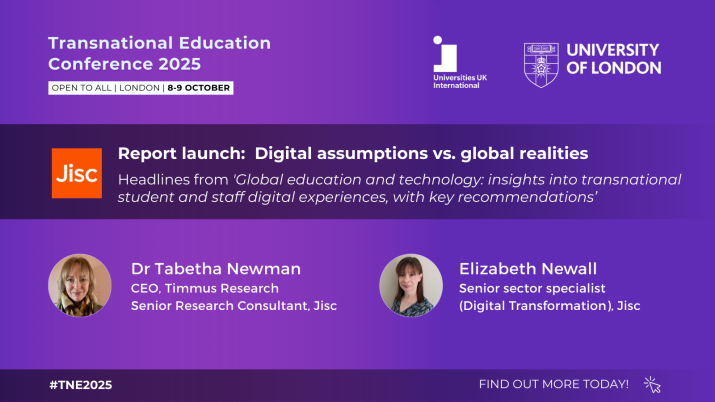
We look forward to summarising the key findings and recommendations during the plenary session on 9 October 2025, and to sharing copies of the report at the event.
