
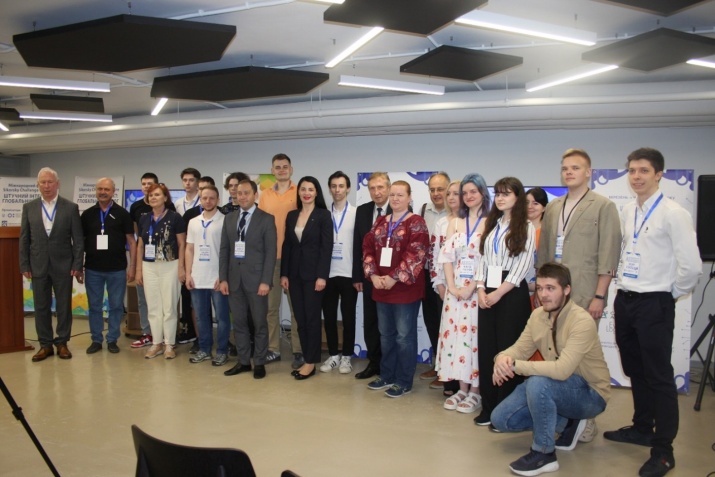
We caught up with the teams from Odesa Polytechnic National University and the University of Portsmouth to find out how their UK-Ukraine Twinning scheme collaboration is tackling fuel station safety and decision-making challenges.
Tell us about your project – what problem have you tried to solve, and how has it gone?
A joint UK-Ukraine project, Multiple criteria fuzzy logic based methodology for risk mapping of gas filling stations and consequent decision optimization, began on 1 February 2023, as part of the UK-Ukraine Twinning grants scheme.
The project was created to solve the problem of assessing the risk of accidents at fuel stations. Building on prior research from the UK on the theory and application of multiple criteria decision-making, and on a PhD study Models and methods of risk zones of potentially hazardous objects analysis in geographic information systems by Oleksii Ivanov, the project team developed a Geographic Information System (GIS) with a built-in decision support module. This system helps to model the potential economic, environmental, and social consequences of accidents. It also provides information on how to manage these situations, for example, by helping decision-makers decide whether to close or upgrade fuel stations in city areas.
When integrated into a city’s environmental service, this GIS raises public awareness about the vulnerabilities of fuel stations that could threaten people's lives, health, the environment and the economy in times of heightened security risk. This work is especially relevant and useful given the ongoing war in Ukraine and current international geo-political tensions.
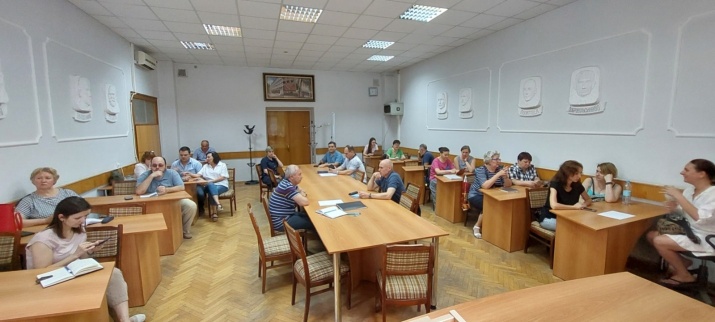
Meeting of project managers of Odesa Polytechnic National University in partnership with the University of Portsmouth, 19 July 2023, Odesa.
What’s been inspiring, challenging or surprising during your work?
Oleksii Ivanov: ‘First and foremost, this was my first experience as a project coordinator for international collaboration on the Ukrainian side. Despite all the challenges, including those related to the state of war in Ukraine, we were able to achieve significant scientific results. This project was a great opportunity for me to develop skills in collaborating with both my colleagues at the department and with leading international scientists. I was also personally interested in the project because it allowed me to continue the research from my PhD, expand the approach to assessing fuel stations, and propose well-considered solutions for decision-makers based on an analysis of accident consequences.’
Vadym Oliinyk: ‘It all started with a task that, at first glance, seemed purely technical: a multi-criteria assessment of the vulnerability of fuel stations. But this project turned out to be something much bigger for me – a personal challenge, a source of professional growth, and my first time speaking publicly after a long break due to the pandemic and the war.’
Olena Arsirii: ‘As the head of the Department of Information Systems, providing scientific advice to the Ukrainian participants was an inspiring experience. This interdisciplinary project, which combined the developments in ecology (the specialized education of Sergiy Smyk and Oleksii Ivanov) and information technology, showed how deep knowledge in different fields can be successfully applied to solve a single problem.
'We saw the professional growth of our department's employees, Oleksii Ivanov and Sergiy Smyk, who have scientific degrees and experience in independent research. Oleksii's achievements in developing the decision-making module and his overall project coordination were undeniable. The addition of Sergiy Smyk to our department started a new scientific direction related to GIS development.
'I’d also like to recognise the contribution of our department's master's students, Vadym Oliinyk and Kyrylo Bieliaiev. Their scientific work received well-deserved recognition, winning an award at the 2024 International Student Research Competition in Artificial Intelligence. I have always believed that our department is one team, focused on achieving impressive scientific and research results. Our joint work on this project was a clear example of effective collaboration and knowledge exchange to achieve a common goal.’
Dylan Jones: ‘It has been inspiring to work with my Ukrainian colleagues, who have managed to maintain the highest scientific levels despite adverse circumstances. On a technical level, understanding and measuring the different ways an incident at a fuel station impacts society, the environment and the economy was a challenging task, and to analyse subsequent decisions were challenging tasks.’
Ashraf Labib: ‘I have found working with our international partners and our local research team to be quite inspiring – especially due to the multidisciplinary nature of the project as it spanned areas of operational research, risk and resilience, as well as artificial intelligence. I am also very pleased that the outcome of this work was featured in a very highly ranked journal paper and has produced excellent research impact.’
What have you learned through your partnership?
First and foremost, as part of the UK-Ukraine Twinning grants scheme, Odesа Polytechnic National University had to develop many documents related to the ethics of scientific research. On the Ukrainian side, the experience of holding regular Zoom roundtables to discuss project results was invaluable, as it helped us manage the project.
On the Portsmouth side, we learnt about Ukraine and some of the scientific and sustainability challenges currently encountered there, as well as from the depth of technical knowledge regarding fuel stations and their impact held by the Ukrainian team.
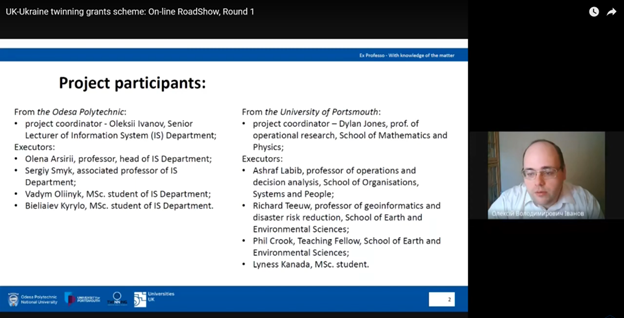
The project coordinator from the Ukrainian side, Oleksii Ivanov (Odesa Polytechnic National University), reports on the results of the first stage of the project at the first session of the Online Roadshow, 6 October 2023, Odesa.
Do you have any tips for other institutions considering developing a partnership with a Ukrainian university or otherwise?
Oleksii Ivanov: ‘Above all, I would advise international partners to be optimistic about filling out grant applications and the possibility of receiving international funding. I believe anything is possible. In terms of collaborating with Odesa Polytechnic, our university is ready to provide a high-quality scientific base for research, as well as the opportunity to communicate with a Ukrainian audience.’
Dylan Jones: ‘Certainly, I recommend considering developing partnerships with Ukrainian institutions such as Odesa Polytechnic. There is a wealth of scientific expertise that can complement your own, perhaps offering a different perspective. We are certainly actively looking for mutual project opportunities that will allow us to continue our partnership with our colleagues at Odesa Polytechnic.’
How has working collaboratively across borders changed how you think or work?
The project established strong partnerships between the universities and forged scientific ties between the Centre of Operational Research and Logistics at the University of Portsmouth and the Department of Information Systems at Odesa Polytechnic. We hope this will lead to further projects, collaborations and joint scientific publications in the future.
What progress or outcomes are you most proud of?
We are most proud that our project was chosen as one of three out of 20 joint UK-Ukraine Twinning Grants Scheme projects between Odesа Polytechnic National University and the University of Portsmouth in 2023 for a small extension from June to September 2024, thanks to additional programme funds.
Within a short collaboration period (a total of 10 months), we managed to publish three articles indexed in the Scopus scientific database and participated in eight public events and conferences to discuss the project results.
From 4–6 June 2024, the final stage of the 2024 International Student Research Competition in Artificial Intelligence was held at the National Technical University of Ukraine’s Igor Sikorsky Kyiv Polytechnic Institute. The scientific work of the Ukrainian project participants, students Vadym Oliinyk and Kyrylo Bieliaiev, was awarded a second-degree diploma. Their scientific supervisor was the Ukrainian project coordinator, Oleksii Ivanov.
Also, based on his dissertation research and project, the Ukrainian project coordinator, Oleksii Ivanov, was awarded the 2024 Prize of the Verkhovna Rada of Ukraine (the Ukrainian Parliament) for young scientists. This is a significant recognition of the project's importance, as more than 60 scientific works were submitted for the competition.
We are particularly proud of being able to publish our work in the European Journal of Operational Research, an international leading journal in the field of decision analytics.
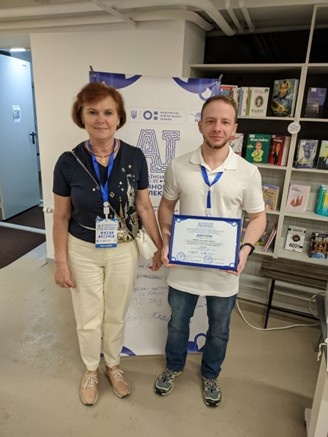
Project participants Arsirii Olena and Vadym Oliinyk are awarded a diploma of the II degree at the 2024 International Student Research Competition in Artificial Intelligence.
What are your future plans?
We are discussing a proposal with the British side to participate in a project to assess the safety of underwater cables as part of The Science for Peace and Security (SPS) NATO Programme. We also plan to publish the research results in a collective monograph, Advances in Information Control Systems and Technologies, based on presentations at the 2023 and 2024 conferences on Information Control Systems and Technologies (ICST).
Words by: Oleksii Ivanov, Olena Arsirii, Sergiy Smyk, Vadym Oliinyk, Kyrylo Bieliaiev, Dylan Jones, Ashraf Labib.