
Researchers at the University of Exeter and National Centre for Scientific Research (CNRS) have begun an ambitious new partnership to understand how civility work is undertaken by public-facing professionals in community policing, healthcare and higher education.
With support from the Department for Science, Innovation and Technology (DSIT) — now the Department for Business, Innovation, Science and Trade (DBIST) — via the International Science Partnerships Fund (ISPF), and Universities UK International (UUKi), we’ve established an innovative interdisciplinary collaboration.
Our project brings together democratic theorists, feminist and ethnographic researchers, and six project partners to examine practices of civility in a cross-national and cross-institutional perspective. We aim to understand civility as a form of labour (through which public-facing professionals seek to sustain relations of respect and equal treatment) and to theorise how this work might repair or corrode conditions of democratic equality.
Why civility matters now
Incivility in public life is widely recognised as a threat to democracy: it deters citizens from standing for office, narrows the diversity of elected bodies, and erodes public trust in political institutions. Yet the impact of incivility extends beyond electoral politics to core social institutions responsible for keeping citizens safe, healthy, and well-informed. Indeed, a ‘crisis of civility’ is increasingly visible in community policing, healthcare and higher education - three domains in which staff often struggle to manage conflict and difficult interactions while ensuring citizens are treated equally and with respect.
In the context of rising inequality, managed decline of social welfare, the immigration crisis, ‘culture wars,’ and repeated service failures, institutions have responded with measures to regulate ‘uncivil’ behaviours. These institutional responses make public-facing professionals responsible for sustaining conditions of democratic equality when citizens encounter public authority in everyday life. Whether in a specialist role or alongside their main job, they undertake effortful and affective relational work that is skilled, demanding, and unevenly distributed yet rarely recognised in its own right. We call this the 'labour of civility.'
Working with our project partners in London and Paris, our project will critically examine how this labour is shaped by policy and institutional pressures, how professionals perform and experience it, and who carries its greatest burdens. We compare community policing, healthcare, and higher education because each involves a different kind of encounter with public authority, and London and Paris because they provide contrasting policy and civic contexts.
From pump-priming to international research momentum
ISPF funding via the UUKi-run Pump-Priming Scheme supported us to organise a co-production workshop at the British Library in February 2025, which brought together academic researchers with partner organisations working directly on questions of civility, public behaviour, democratic culture, and institutional life. Participants included representatives from Civility Saves Lives, the National Union of Students, the Municipal Police of the City of Paris, and the Brigade du respect et du civisme (BRC) Saint-Ouen-sur-Seine.
Following the workshop, ISPF funding also enabled Andrew Schaap (Exeter) to travel to Paris to collaborate intensively with Carole Gayet-Viaud (CNRS) in developing a project proposal for a large grant. While this was initially conceived around a Horizon Europe call on the emotional politics of democracies, we adapted strategically when the funding landscape changed, leading us to instead develop an application for an Economic and Social Research Council (ESRC) standard grant.
When the ISPF funding came to an end, additional seed funding from the University of Exeter, Paris-Saclay Université and UC Louvain enabled us to further develop our project by organising additional practitioner workshops in 2025 at Conway Hall in London on civility around the university and on street (in)civilities at UCLouvain in Belgium (see video below).
In January 2026, we organised a panel on Is Civility Reactionary? at the Britain and Ireland Association of Political Thought conference in Edinburgh. Papers from the panel are now being developed into a special issue of the Review of Politics, extending the project’s intellectual contribution to wider debates in political theory.
This momentum continued in March 2026 with a Critical Exchange on Derek Edyvane’s The Politics of Politeness, hosted by the Birkbeck Centre for British Political Life, which is forthcoming in Contemporary Political Theory.
We also convened a workshop on The Political Theory of Civility: Negotiating Respect in Public Life at the European Consortium for Political Research Joint Sessions in Innsbruck in April 2026. Papers from the workshop will form a special issue of Citizenship Studies.
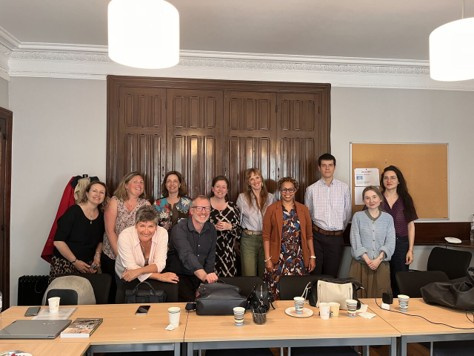
We hosted a further co-production workshop in Paris on 3 June 2026 (pictured above), which brought together the academic research team with partners from city councils, public hospitals, universities and non-governmental organisations from London and Paris (from left to right on the picture): Saskia Garner from Suzy Lamplugh Trust, Claire Lambard from CPED - Chargé·es de mission Égalité-Diversité de l'enseignement supérieur, Marie-anne Fourrier from Assistance Publique–Hôpitaux de Parishttps://www.aphp.fr/, Mary Meekings from the University and College Union, Maria Clement from Civility Saves Lives, and Etienne Cagniart from Paris Municipal Police.
Since our first co-production workshop in February 2025, made possible through ISPF funding, our project has evolved into a substantial programme of collaborative research, publication and practitioner engagement. It aims to make visible who performs civility work in public institutions, under what conditions, and with what consequences for democratic life.
We submitted an application for an ESRC standard grant (£1m) in September 2026, for which Andrew Schaap (Exeter) is a Lead Investigator and Carole Gayet-Viaud (CNRS) International Co-Investigator, together with Bice Maiguashca and Katharine Tyler (Exeter), Suzanne Whitten (QUB) and Derek Edyvane (Leeds). If successful, our project will commence on 1 September 2027.
Words by: Andrew Schaap (University of Exeter)
UK–France Science, Innovation and Technology Pump-Priming Scheme call one projects were funded by the Department for Science, Innovation and Technology's (now the Department for Business, Innovation, Science and Trade's) International Science Partnerships Fund (ISPF).