
Dr Sarah Fuchs (Royal College of Music) reflects on her project, Recording Vocal Difference and Disability at the Institution Nationale des Sourds-Muets, 1901–1937, funded by a UUKi UK-France Science, Innovation and Technology Pump-Priming grant.
Working alongside project partner Dr Henri Chamoux (Laboratoire de Recherche Historique Rhône-Alpes) and research assistant Apolline Gouzi, Dr Fuchs discusses how listening is shaped by personal background and expertise. By bringing together diverse groups of listeners — from singers to sound engineers — to examine early 20th-century wax cylinder recordings, the project reveals how interdisciplinary collaboration can transform our understanding of historical sound archives, vocal difference and ethical digital curation.
The skill(s) of listening
Listening tends to be treated as a universal skill: something we all know how to do, and something we all do in more or less the same way. In fact — and as I came to understand more clearly than ever in the course of the research described here — this could not be further from the truth. How we listen is highly individual, informed by (among many other things) our expectations, experiences, and expertise. How I listen, for example, has a lot to do with my long training as a professional musician, and subsequently as a music historian.
With the support of a UUKi UK-France Science, Innovation and Technology pump priming grant — for a project entitled ‘Recording Vocal Difference and Disability at the Institution Nationale des Sourds-Muets, 1901–1937’ — I recently spent several months listening to a little-known collection of early twentieth-century wax cylinder recordings in the company of listeners with very different expectations, experiences, and expertise from my own. My aim, in part, was to test the limits of my own listening skills, and perhaps even to begin hearing things in these recordings I had never heard before.
The Laboratoire de la Parole’s wax cylinder recordings
Now held by the Bibliothèque Nationale de France, these wax cylinder recordings were made in the Laboratoire de la Parole (Speech Laboratory) of the Institution Nationale des Sourds-Muets de Paris (the Paris branch of the French National Deaf-Mute Institution).
From its founding, the Laboratoire de la Parole was an important hub for interdisciplinary research into voice and speech problems of all kinds, and thus these recordings capture an extraordinary array of voices. Many belong to the Institution’s deaf students, who — in line with pedagogical practices that were much contested even in their own time — were being taught to communicate via speech rather than sign language.
Others belong to people with more specific vocal concerns: non-native French speakers, soldiers suffering from physical and psychological injuries sustained in the First World War, and even professional opera singers struggling with their voices in various ways. Recorded as they were in a private laboratory and not for public consumption — perhaps not even intended to be listened to more than once or twice — these recordings raise thorny ethical questions about how we preserve and patrimonialise our sonic heritage, particularly in the digital age.
Listening otherwise
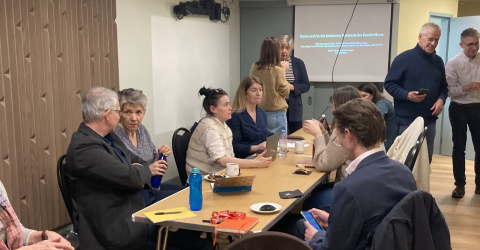
In March 2025, with support from the UK-France pump priming grant, I organised a workshop on ‘Opera and/at the Institution Nationale des Sourds-Muets’ at the Royal[LB1] [SF2] College of Music, London, in collaboration with my project partner Dr Henri Chamoux (Laboratoire de Recherche Historique Rhône-Alpes, UMR 5190) and our project research assistant Apolline Gouzi. After presenting our preliminary findings, we invited the participants to listen to several of the recordings — mainly the operatic ones, in deference to the setting — and then discuss what they had heard.
Just as we hoped, this exercise helped us hear these recordings in new ways. It also drew attention to just how differently even those we consider ‘expert listeners’ hear. What the singers picked out, for example, was strikingly different not only from what the sound engineers or speech therapists noticed, but also from what their fellow singers did — even when they were listening to exactly the same passage.
To some small degree, we found ourselves ‘listening otherwise’, as Dylan Robinson puts it in his 2020 Hungry Listening: Resonant Theory for Indigenous Sound Studies — that is to say, listening with an awareness of our own positionality, of all we were not able to hear.
Listening still
Since the UUKi UK-France Science, Innovation and Technology pump priming grant came to an end, the collaborative research activities seeded by this funding have continued to bear fruit, contributing to several conference presentations and publications.
Just as importantly, the grant has helped to build capacity for future work. Drawing on the partnerships and pilot findings developed here, we are now preparing a funding bid for a much larger five-year European Research Council Consolidator Grant, which will explore the afterlives of early recordings in the digital age. It will focus especially on how they are transferred from analogue to digital (and how that shapes what listeners now hear as the recording), how cataloguing regimes for recorded sound have evolved over the past century (and what they have retained/erased along the way), and how curatorial practices have evolved alongside both of these practices (and alongside a wider impulse towards digital access and democratisation).
The listening exercise described above — which we had initially imagined to be a one-off event — has been repeated several times since, each time with a different group of expert listeners, and each time revealing something new. I embarked on the project thinking I would be listening mainly to voices from the past. However, thanks above all to the bilateral structure of the grant, it is the input of colleagues from different disciplines, scholarly traditions, and national institutions to which I have ended up paying the most attention. Together, we have begun to lay the foundations for a multi-disciplinary mini-field located at the crossroads where musicology, sound studies, the history of science and medicine, d/Deaf studies, and archival practice meet.
Its central questions are, in large part, those with which the project began: how vocal difference and disability were understood and recorded in early twentieth-century France and elsewhere; what these recordings can — and cannot — tell us about the people whose voices they capture; and how collections made in such circumstances might be responsibly preserved, catalogued, and shared today. None of these questions belongs to a single discipline, which is precisely why the conversations the grant has made possible have proved so valuable.
The most immediate impact of all of this listening has been on us listeners, of course: listening alongside one another has led, quite naturally, to mutual learning. But what we have learned together is also beginning to register more widely, not least in helping to shape the curatorial practices that will determine how, and whether, these sensitive sound recordings will be made available to a larger audience around the world.
Looking ahead, we hope this work will help establish ever more ethically attentive frameworks for the stewardship of comparable collections elsewhere; deepen public understanding of the voices recorded at the Laboratoire de la Parole and of the histories these recordings carry; and bring a broader community of listeners — academic and otherwise — into conversation with this remarkable collection. The echoes of these collaborative activities will, I hope, continue to be heard for many years to come.