
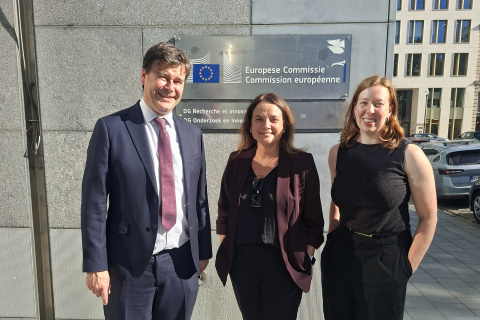
Earlier this month, Universities UK International (UUKi) led a small delegation of UK university leaders in Brussels as part of a Wellcome-funded initiative aimed at strengthening relationships with key European stakeholders and championing the UK's role in Europe's research and innovation landscape.
The visit came at a significant moment. With discussions intensifying around the EU's next Multiannual Financial Framework (2028–34), policymakers are beginning to shape the future of major funding and innovation programmes, including Framework Programme 10 (FP10) and the European Competitiveness Fund (ECF). Ahead of formal negotiations between the European Commission, Parliament and Council, our delegation sought to contribute to the conversation, and to better understand the opportunities and challenges that lie ahead.
A shared ambition among associated countries
One of the clearest messages from the day was the growing appetite among associated countries to work together and ensure their perspectives are reflected in the design of future European programmes, and that these programmes remain open to trusted like-minded countries.
Discussions with representatives from like-minded associated countries demonstrated the value of a collective voice. Building on initiatives such as the joint statement on future association arrangements signed by the embassies of 10 associated countries on 31 August 2026, there is a strong sense that countries contributing significantly to Europe's research ecosystem should have meaningful opportunities to shape its future direction.
While each associated country brings different strengths and priorities, and have different legal frameworks underpinning participation, there was broad agreement that closer collaboration can help ensure that future programmes remain open, excellent and globally competitive.
The delegation also discussed emerging debates around strategic technologies and dual-use research. As Europe seeks to strengthen competitiveness and resilience, there is a risk that additional restrictions could unintentionally limit collaboration with trusted partners. A key takeaway from these conversations was the importance of maintaining openness wherever possible and ensuring that countries such as the UK continue to be able to contribute fully to shared research and innovation ambitions.
Understanding the evolving FP10 and ECF landscape
Meetings with UK stakeholders based in Brussels and officials from across the European Commission gave us essential insights into how thinking is developing around FP10 and the proposed European Competitiveness Fund.
A recurring theme throughout the discussions was the importance of recognising the contribution that trusted, like-minded countries (including the UK) make to European research and innovation. Participants emphasised the role that international collaboration plays in maintaining research excellence and tackling shared global challenges.
The delegation also explored the increasingly interconnected nature of FP10 and the ECF. While opportunities for closer alignment between research, innovation and competitiveness are welcome, questions remain around how association arrangements could operate across future funding mechanisms and what this might mean for countries outside the EU.
The importance of certainty
Another key lesson was the importance of predictability and continuity. Universities, researchers and innovation partners need clarity if they are to build long-term collaborations, develop ambitious projects and invest in new partnerships. There was strong support for timely association arrangements that provide confidence from the outset of future programmes, helping to avoid the uncertainty experienced in previous funding cycles. Certainty and clarity at an early stage matter not only for institutions, but also for the wider research ecosystems that depend on stable international partnerships.
Throughout the visit, UUKi shared findings from our recent report, Realising our potential: UK participation in Horizon Europe. The report highlights practical steps that can help maximise the benefits of UK association and strengthen participation across the research community.
The findings of this research resonated with many of the stakeholders we met, particularly around the need to remove barriers to participation and ensure that collaboration remains attractive, accessible and mutually beneficial, and that timely association provides the certainty needed.
What’s next?
Perhaps the most encouraging outcome of the visit was the enthusiasm we encountered for continued engagement with the UK higher education sector.
Across meetings, there was clear recognition of the UK's contribution to European research excellence and a genuine interest in maintaining strong partnerships into the next funding period.
At the same time, the discussions reinforced a wider point: as the number of associated countries grows, so too should opportunities for those countries to contribute to consultations, decision-making discussions and the broader strategic direction of Europe's research and innovation programmes.
If Europe is to maximise the impact of FP10 and related initiatives, it will need to draw on the expertise, investment and perspectives of all its partners. Strengthening the voice of associated countries will be an important part of achieving that goal.
As negotiations continue over the coming months, UUKi will remain engaged with partners across Europe to ensure that UK universities are well positioned to contribute to, and benefit from, the next chapter of European research collaboration.