
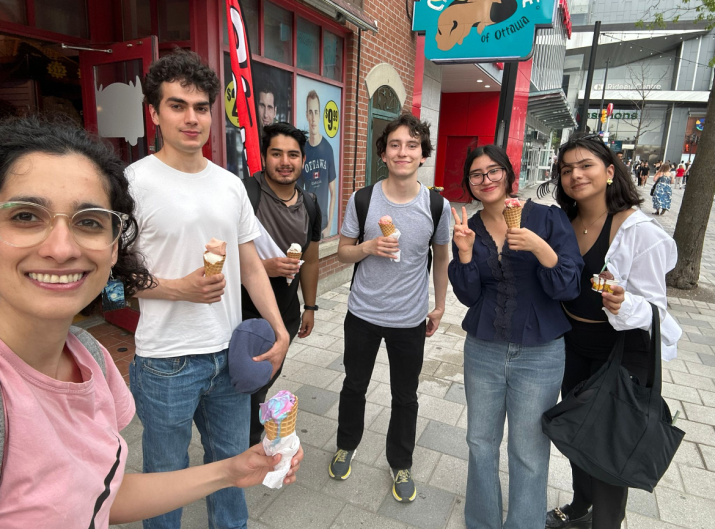
Zohra Amin (Law with Business student at the University of Exeter) discusses her experience of a Globalink Research Internship placement in Ottawa, Canada.
In May 2026, I flew to Canada by myself for the first time in my life. Twelve weeks later, I’ll fly home knowing exactly what I want to do with my career. That isn’t something I expected one summer to hand me.
I’m a Law with Business student at the University of Exeter, about to start my final year, and this summer I’m a Mitacs Globalink Research Intern: a fully funded, twelve-week research placement at a Canadian university. If you’re a UK undergraduate wondering whether to apply, you definitely should.
Why I said yes
The honest answer is that there was no reason not to.
The internship is fully funded – including flights, accommodation, insurance and a generous living stipend – so I didn’t have to worry about the financial side of things.
It was also my first time travelling solo, my first time living abroad, and a chance to work one-to-one with a leading academic in a research field I really care about. Through the programme, you contribute to scholarship and build skills that appeal to employers and law firms.
The city that surprised me: Ottawa
I knew almost nothing about Ottawa before I arrived. Now I’d tell anyone who’ll listen to visit.
Canada’s capital is beautiful: leafy and calm, and built around a river and a canal. It still feels like a city, but it’s much calmer than I expected – especially compared to London. People here are warmer and kinder. I spend my afternoons walking the city, and I still notice it every day.
The University of Ottawa makes it better still. It’s the largest bilingual English-French university in the world and is ranked among the top ten universities in Canada. This strong academic environment makes the experience even more valuable.
The research: how law talks about belief and the body
The research aspect of the programme has been the most interesting part for me, and I could talk about it for hours.
My project is The legal construction of religion and non-religion: reproductive rights. In plain terms: I study how the law shapes what counts as a religious or non-religious belief, and how those categories play out in public debates about reproductive rights and bodily autonomy, i.e. who gets to make decisions over their own body. I do it comparatively, across Canada, the United States and the United Kingdom, because each country draws those lines in different ways.
To get there, I’ve learned a research toolkit. The first tool is called ‘coding'. Different from computer coding, in research coding means reading a text closely and tagging it, marking the recurring themes and arguments until patterns rise. I’ve also learned critical discourse analysis: the study of how language is used to frame an issue, persuade an audience, and carry values and power. Then I pull it all into comparative reports that set the three countries side by side.
None of this would have been possible without my supervisor, Professor Lori Beaman, the Canada Research Chair in Religious Diversity and Social Change. She has taught me so much in a matter of weeks, and I count myself really lucky to work under her. I’m just as lucky in my colleagues. The office is full of people who are sharp, warm and very funny, and I look forward to going into the office each morning.
A day in the life
I’ve come to love my daily routine in Canada. I wake around 8am, have breakfast, and barely have to walk at all to reach the Desmarais building where I work, which sits directly opposite my accommodation.
I make a cup of tea and settle into the morning’s reading. Then I move into coding, pulling out the passages that matter, and spend the early afternoon analysing them closely, usually until around 3pm. After that, the day is mine: the gym, lunch, and a long walk around the city. It’s a healthy balance of meaningful work in the morning and space to think in the afternoon.
How it changed my plans
Reading so much law about rights, belief and the body has helped me decide my next steps, and I now know I want to specialise in human rights law.
I’ve found the part of it that really keeps me engaged, which feels quite rare.
Should you apply?
Absolutely, yes.
A few practical notes if you’re tempted. The GRI is open to UK undergraduates with a year of study still to go after the internship, it runs for 12 weeks over the Canadian summer, and your home university has to nominate you, so I recommend first sending a short email to your study abroad team to let them know you’re interested in the programme.
This is a really valuable opportunity, especially if you want to work or live abroad. The worst that can happen is a ‘no’, and the best is a summer where you gain experience doing work you love in a completely new place.
I’m really glad I applied. It’s one of the best decisions I’ve made.