

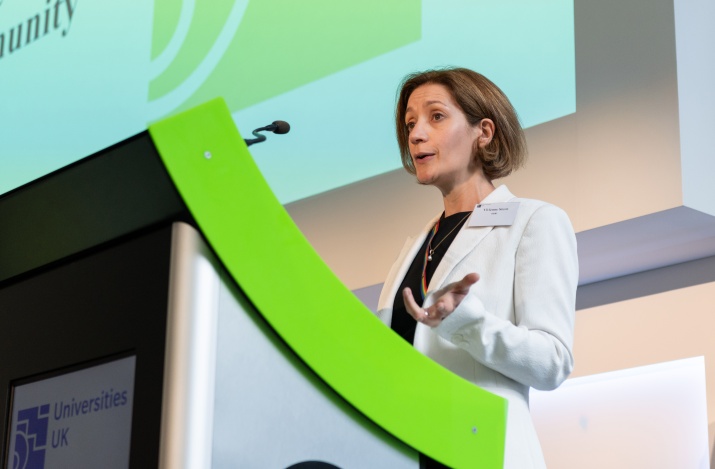
Speaking at our annual conference in her home town of Leicester, Vivienne Stern sets out her priorities in her first speech as Universities UK's Chief Executive.
As some of you know, this is my home town. I studied for my A-levels in the university library here because at that point you had zero security and a great paternoster. I played badminton in De Montfort University’s (DMU) sports hall. The universities, or more particularly their students, gave the city a pretty good nightlife.
For me, the boundaries between the universities and the city were permeable. I watched these universities change the city. And they keep changing it.
I watched these universities change the city. And they keep changing it.
DMU has completely transformed the old hosiery district around the campus, while keeping close links with the garment industry which still exists here. Together with Loughborough University, these universities were among the first to launch a civic university agreement, combining their respective strengths, to collaborate with five local authorities in the long-term interests of this area.
Between them, these three institutions contribute £1 billion to the Leicester and Leicestershire economy, and support 17,000 jobs. In a place like this, that’s staggeringly important. Indeed they estimate that about one in 25 local jobs are supported by these universities, by the talent they attract, the students they educate, and the companies which establish themselves and grow here.
A city like Leicester needs its universities for all these reasons. And every story we need to tell about why our universities matter could be told from here.
We’re facing a wall of challenges – not just in England but in all four nations of the UK, and the list keeps getting longer.
From the way DMU incubates start-ups and supports local small and medium-sized enterprises; to the creation of the new Space Park; and the thousands of convictions secured on the back of DNA fingerprinting: these universities make a real difference in the world.
This is why I regard it as a privilege to have the opportunity to lead Universities UK. I am grateful for the trust that you – Professor Steve West and the Board – have placed in me. I am not sure it is going to be fun exactly. But it is important.
Challenges ahead
We’re facing a wall of challenges – not just in England but in all four nations of the UK, and the list keeps getting longer.
A new prime minister with her back against the wall; an economic crisis; growing alarm across our campuses about the impact of the increasing cost of living. Your own cost pressures, already great, will escalate with rampant inflation and rising energy costs.
Meanwhile the Treasury is worried about a lot of things, I guess, but it’s not particularly worried about you. So the expected Spending Review presents a real risk, especially to the research budget set aside to fund Horizon alternatives.
I have heard one thing over and over again in many different forms: Get off the back foot.
These join the serried ranks of our existing policy challenges, some of them common, some of them distinct to each of the four nations.
I could list them, but I’d just depress you.
So, when people ask me if I am excited about taking up this job, I have to say no: I am braced for a difficult period.
I want to thank those of you who have helped me prepare, through hundreds of hours of conversation. I have visited many institutions to hear from your senior teams about what is most important. I have joined discussions in Scotland and Wales, with specialist institutions, and with many people outside the sector who care about us.
I have heard one thing over and over again in many different forms: Get off the back foot.
Now, I have been around the block enough to know how hard that is. I also know that we will continue to be buffeted daily by the things that come at us, from the media; from ministers – and, as they say ‘events….’.
But these stiff headwinds must not drive us back into a corner. We have to make a decision – are we just here to mitigate the worst of it, or can we create the space to set our own agenda – to make the weather?
And if we do, what would we want to achieve?
Our purpose
I was in Aberdeen last week, and George Boyne quoted their founding ambition:
...to found a university, which would be open to all and dedicated to the pursuit of truth in the service of others.
To be fair there was another one, which had something to do with reducing the terrible ignorance of the people of Aberdeen, but it is probably wisest not to dwell on that one. But that statement, to be open to all and dedicated to the pursuit of truth in the service of others: that’s beautiful.
It is also remarkable that the same mission has survived pretty much intact for over 500 years. It is still, I would argue, the essential function of all of our universities. My guess is that you all have founding statements which say something a bit like that.
I am not going to start down some sort of fuzzy quest for the purpose of the university. What I mean to say is that our purpose as Universities UK (UUK) should be drawn directly from the purpose of the institutions we serve.
Our purpose should be focused on what will make our wonderful universities better able to serve that fundamental mission.
Over the course of the next year we’ll have the opportunity to work together to shape a new strategy for UUK. I’d like that strategy to be based on a long-term vision of the small number of things we think need to change for our universities to serve society better in the future than they do today.
I’d like us to be able to tell politicians in all four nations what role we want them to play, and not just the other way around. We can make common cause with ministers and policy makers; with business and communities; with the NHS and with our great cultural institutions, sometimes by rallying to their flag, and sometimes by raising our own.
Setting a positive agenda has to be balanced with a better defence of our universities from the constant drip, drip, drip of negative commentary, which feeds a growing chorus of voices arguing that universities have lost their way.
We won’t be able to disprove every criticism, and neither should we try, but we can choose one or two central themes of disquiet, and work gradually, patiently and over the long term to address them.
That’s about much more than a snappy media retort. It’s about picking our battles and being prepared to put the resources behind them. It’s about looking for allies and making common cause where we can.
We’re already working to reshape our approach, and tomorrow you’ll have the opportunity to discuss a major perceptions study which will inform that work. It’s just a beginning. We want to work more effectively as a team, with your colleagues, to open a window on the life of your institutions, and to increase understanding of what they really do.
We want to work more effectively as a team, with your colleagues, to open a window on the life of your institutions, and to increase understanding of what they really do.
One of the great joys of working in UUKi was the extent to which we were connected with your senior staff on the international side – the pro vice-chancellors, the international directors, to global engagement folk. I’d like UUK as a whole to be better connected.
Our credibility with government comes from our ability to accurately reflect and represent what you think, and what your universities experience. It also allows us to be genuinely helpful to government.
But perhaps more fundamentally, it allows us to act together when we need to take a leadership role and address a problem. I am struck by just how much of UUK’s work, now and in the past, has been in this mode – convening the sector to act together to change something about the way we work, or to work together towards a common goal. We do it through concordats, statements of principles and guidance and occasionally by spinning out whole organisations. It’s an expression of the sector’s own responsibility and active pursuit of continuous improvement.
It’s far more collaborative than you’d think possible in a highly competitive sector. It’s central to our character as an organisation. We’re not just lobbyists sitting on the sidelines and complaining about stuff, but powerful actors, individually and collectively, with tremendous capacity to make big changes.
That’s pretty awe inspiring. I’ve seen it in the way the sector has come together to support Ukrainian universities through the Twinning Scheme. We did it during the pandemic. We’re doing it on security and risk; grade inflation; the degree attainment gap; mental health; harassment; research careers and many other fronts.
Four priorities
But we’re going to have to be careful how much we take on. We’re not a huge organisation, and everything we choose to do stops us doing something else, or risks diluting our impact. As a membership body, we need to work with you to determine a smaller number of priorities. We also need to be robust about what we take on at the request of our governments.
Those priorities must be defined in conversation with you. But I will sketch out four areas which seem important to me:
Growth
The language of levelling up may stay or go, but the central concern about the UK’s lacklustre economic performance and the inequality of wealth distribution will remain. This is not about currying favour with the new prime minster.
This is our business. I’d like UUK to talk more about research and innovation, to make a powerful and evidence-based case for the role universities can play in improving the UK’s economic performance, with ideas for how policy can enable you to make a bigger contribution. Preserving the current commitment to investing 2.4% of GDP in research and innovation is essential – and not to be taken lightly in the current climate.
Quality and value
We know our reputation on this front is being eroded. It must be a priority to articulate the value of a university education – across the disciplinary mix – and be seen to be the guardians of quality, not the villains of the piece. More of our time and resources should go into this because it is so fundamental to our ability to create the right political conditions.
Financial sustainability
I put it third because the rationale flows from the first two. This is a problem for all of our universities, although it has different characteristics in different nations of the UK. Given the current economic and politicial situation it is also going to be fiendishly difficult to prevent things getting worse, let alone get us on a path to improvement.
In England we’ve just had a major review of the financing of teaching. Its results have not yet been implemented, but there’s still a sense that we’re going to have to come back to this. Many people tell me, in England anyway, that the current system can’t survive. Others will argue that we call for a fundamental rethink at our peril. All the other options could be worse.
I don’t know what the answer is, but I strongly believe we ought to have one. We have to know what we think a better approach would look like, and our answer has to be responsive to the concerns of all those who have a stake in the system. We also have to pick our moment to blow the whistle on this debate. I recognise that moment may not be now.
Climate crisis
The climate crisis would have been a bigger part of our work in UUK if it hadn’t been for the pandemic. We’ve done good things – thanks to the leadership of Judith Petts working with Julie Tam – but it’s just a start.
I think there are two reasons for prioritising this, despite all the competing demands we face. The first is that universities have such enormous potential to accelerate the shifts we need, technologically and in behavioural terms, to limit emissions, achieve net zero and adapt to the changing climate.
But secondly because this is going to be quite literally everyone’s business, so the people who are educated in our universities need to be able to lead the changes that will affect every part of life. I was strongly reminded of that in a recent visit to the University of the Arts London. Their fashion and design students, who will have to change the industries they are joining and are being trained to do just that. I think we can play a real leadership role here, and that it is our responsibility to do so.
For the blink of an eye, we’re the temporary custodians of our university system. We’d better try to leave it in a better state than we found it.
I have talked a lot about responsibility. That’s the way I see this job. For the blink of an eye, we’re the temporary custodians of our university system. We’d better try to leave it in a better state than we found it.