
Skip to main navigation Skip to main content
Home
  • About us
    • Introducing UUK
    • Our members
    • Careers
      • Vacancies
      • What it's like to work at UUK
      • An inclusive, diverse place to work
    • Our history
    • People
    • Governance, annual reports and accounts
      • Articles of Association
      • Our Board
      • Membership criteria
      • Annual reports and accounts
    • Who we work with
    • Our home: Woburn House
  • Topics
    • Teaching, learning and quality
      • Quality and standards
      • Regulation
      • Ways of learning
      • Working with employers
      • Freedom of speech
    • Funding, finance and operations
      • Security and risk
      • Transformation and efficiency
      • University funding
      • Pensions
    • Impact of universities
      • Communities and social responsibility
      • Discoveries, inventions and global challenges
      • Skills and economy
      • Transforming people’s lives
    • Research and innovation
      • Innovation and big ideas
      • Knowledge exchange
      • Research and funding
      • Research standards, ethics and culture
    • Health and wellbeing
      • Mental health
      • Suicide prevention
    • Equality, diversity and inclusion
      • Improving social mobility
      • Opportunities after graduation
      • Safe and inclusive campuses
      • Student success
    • Students
      • Admissions
      • Student finance
      • Student support
      • Student voices and experiences
    • Climate and sustainability
    • International
      • International experience and mobility
      • International research collaboration
      • International staff and students
      • Ukraine
  • What we do
    • Policy and research
      • Policy: an overview
      • Publications
      • Policy & Research team
    • Supporting our members
      • What we do for our members
      • Member benefits
      • Supporting vice-chancellors
      • Events
        • Speak at our events
        • Sponsorship Opportunities
        • Events team
      • Members' meetings and conference
      • Partnership with Studiosity
      • Specialist Institutions Forum
      • Strategy, insight and member engagement team
    • Creating a voice for our members
      • An overview
      • Campaigns
        • Unlock potential with contextual admissions
          • Introduction
          • How to get involved?
        • Industrial strategy
          • Introduction
          • Supporting evidence
          • Advanced manufacturing
          • Clean energy industries
          • Creative industries
          • Defence
          • Digital and technologies
          • Financial services
          • Life sciences
          • Professional and business services
        • Access to success
          • Our action plan for opportunity: making the difference for students  
          • Unlock potential with contextual admissions
          • Collaborate in local cold spots to raise aspirations
          • Set up all students for success with an adequate maintenance package
          • Create career-ready graduates with targeted careers services
        • Unis start up the UK
          • How do universities support start-ups?
          • What impact do start-ups have?
          • What’s the future of university start-ups?
          • Case studies: Enhancing educational outcomes
          • Case studies: Harnessing the tech revolution
          • Case studies: Improving everyday life
          • Case studies: Powering the energy transition
          • Case studies: Promoting sustainable solutions
          • Case studies: Supporting a healthier nation
        • #WeAreInternational
          • The campaign
          • Campaign resources
          • #WeAreInternational student stories
          • #WeAreInternational: Transforming Lives part 2
        • #TwinForHope
          • The campaign
          • Background
          • Our impact
        • Our past campaigns
          • 100 faces
          • Powering the NHS
            • Five-point plan for healthcare education and training
            • Survey of young people's attitudes to NHS careers
          • Getting Results
          • Made At Uni
          • We Are Together
      • Media releases
      • Media team
      • Communications team
    • International
    • Work in parliament
      • Political affairs: an overview
      • All-Party Parliamentary University Group
      • Parliamentary briefings and submissions
      • Political Affairs Network
  • Latest
    • News
    • Events
      • Past events
    • Insights and analysis
    • Newsletter
    • Podcasts
    • Publications
  • Media
  • Events
  • International

Search

  • - Any -
  • Covid
  • Equality, diversity and inclusion
  • Funding, finance and operations
  • Health and wellbeing
  • Impact of universities
  • International
  • Research and innovation
  • Students
  • Sustainability and climate
  • Teaching, learning and quality
  • - Any -
  • UUKi Blog
  • UUKi Insights
  • Insights and analysis
  • Media releases
  • News
  • Publications
  • UUKi Publications
  • UUKi News
  • - Any -
  • Campaign
  • Event
  • Basic page
  • Profile
  • Newest first
  • Oldest first
  • A -> Z
  • Z -> A
  • Relevance

Or browse by topic

  • Teaching, learning and quality
  • Funding, finance and operations
  • Impact of universities
  • Research and innovation
  • Health and wellbeing
  • Equality, diversity and inclusion
  • Students
  • Climate and sustainability
  • International

Breadcrumb

  1. Home
  2. What we do
  3. Creating a voice for our members
  4. Campaigns
  5. Industrial strategy

Advanced manufacturing

The advanced manufacturing sector plays a pivotal role in driving growth by enabling UK manufacturers to develop innovative products and integrated product-service solutions that meet the evolving demands of future technologies.

Case studies

Medical Device Manufacturing Centre, Heriot-Watt University, Edinburgh University, Glasgow University, Robert Gordon University and University of Dundee
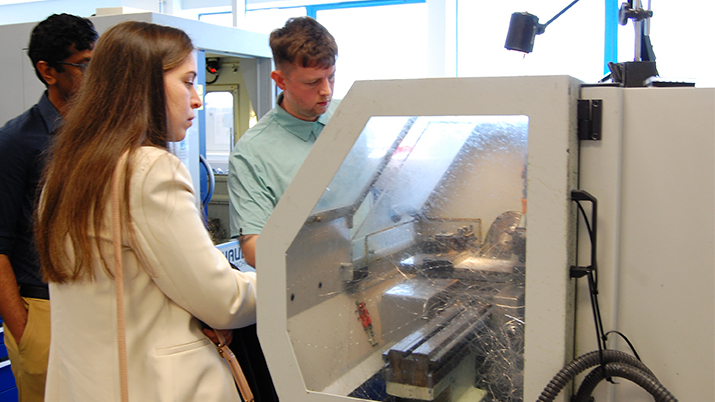
MDMC centre precision engineering launch with two scientists in lab coats.

MDMC centre precision engineering launch

The Medical Device Manufacturing Centre (MDMC) provides developers and manufacturers with the advice, technical expertise and facilities essential for companies that are seeking to translate medical device concepts to commercial products.

The centre opened in 2020 with a simple idea – to remove the practical barriers that often stop Scottish med-tech ideas from reaching patients. Headquartered at Heriot-Watt University, the centre is a partnership between five Scottish universities: Dundee, Edinburgh, Glasgow, Heriot-Watt and Robert Gordon. Backed by Scottish Enterprise, the centre offers companies fully funded access to 67 manufacturing processes, regulatory insight, clinician links and a range of services that previously existed only in silos.

By combining academic research, industrial pace and NHS realism over the past five years, the centre has rapidly grown, proving the model works as a national launchpad for safer, greener medical technology. Successes include shortening the gap between concept and clinical adoption, growing Scotland’s med-tech economy and embedding sustainability into device design.
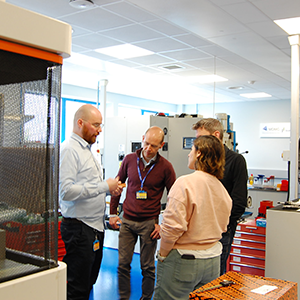
MDMC centre workers at a precision engineering launch
MDMC centre precision engineering launch.

More recently, the centre has delivered 39 industry projects (+45% year-on-year), helped firms secure £7.5 million in new investment and created 42 high-value jobs by working with 170 Scottish companies. 

Support for Scottish companies is provided via 24 open-access webinars, CPD courses and an annual conference. The centre has 20 specialists across Scotland, at Heriot-Watt, Edinburgh, Glasgow, Dundee, and Robert Gordon Universities and NHS partner sites, uniting to create a virtual team.

CISM: Driving the UK’s semiconductor skills agenda, Swansea University

The Centre for Integrative Semiconductor Materials (CISM) is an initiative to bring together semiconductor and advanced materials platforms to research and develop new technologies and products at Swansea University.

As part of the South Wales Compound Semiconductor Cluster, the university is delivering education, skills and outreach programmes for talent pipeline development for the rapid-growth, strategically vital semiconductor sector.

This includes the flagship Royce Cleanroom Skills Course, providing students with practical hands-on experience in semiconductor fabrication, making real compound semiconductor chips in the £60M CISM fabrication facility during a five-day residential course. This programme equips students with vital technical skills and safety knowledge essential for semiconductor industries.

Supported by Innovate UK and EPSRC PBIAA, Swansea is also pioneering immersive outreach, deploying VR and AI-powered experiences that allow students to virtually explore semiconductor labs and cleanroom environments. Over 10,000 participants have engaged with these tools to date, showcasing the power of digital engagement in STEM education.

Swansea has also engaged over 100 secondary schools in semiconductor-focused outreach activities combining sport, science and industry awareness. Such innovative partnerships include Dragons Rugby and Vishay, while collaborations with Careers Wales and the Engineering Education Scheme Wales help raise awareness of semiconductor careers from a young age. Together, these initiatives reach thousands of learners annually.
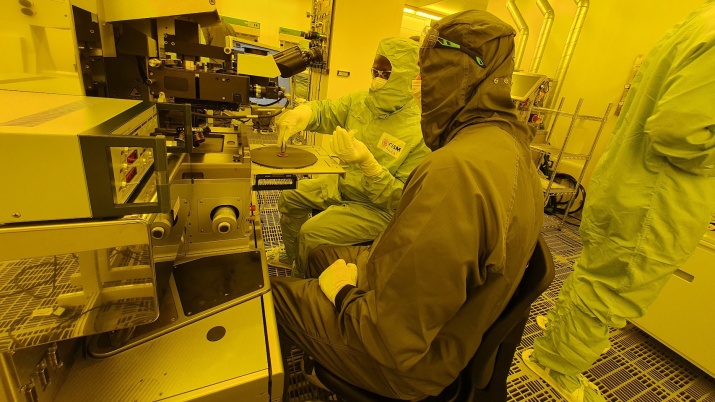
Cleanroom Training Swansea University

Cleanroom training at Swansea University

AeroSolar: A new approach to solar power, Queen Mary University of London

AeroSolar are taking perovskite solar from concept to reality. The Queen Mary University of London spinout is developing a scalable method for manufacturing perovskite solar films – a lightweight, flexible and efficient alternative to silicon. Perovskite can be installed on surfaces that cannot support heavy panels, unlocking sites previously unsuitable for solar power.

Almost 30% of commercial rooftops worldwide cannot bear silicon’s weight, and only 2% of buildings generate solar. Silicon production also has a high carbon footprint and concentrated overseas supply chains. However, turning to alternative materials to scale has proven difficult, with perovskite manufacturing notoriously difficult.

One of the issues with silicon is that it’s close to its maximum efficiency ... and so we need new technology to try and overcome these challenges.

Professor Joe Briscoe

To address these barriers, Queen Mary’s Professor Joe Briscoe developed an aerosol-assisted solvent treatment to improve manufacturing speed, quality and consistency while lowering costs. With £50,000 Innovate UK funding, AeroSolar is building a large-scale reactor to move towards commercial production.

Solar start-up and industry partner of QMUL, Power Roll, estimates 12 billion square metres of UK rooftops could host perovskite, generating electricity at less than a quarter of current grid costs, representing a £250 billion market.

This will offer extraordinary possibilities for cheap, flexible solar cells in a range of applications.

Remote video URL

NCC: Transforming today’s industries and creating tomorrow’s, University of Bristol
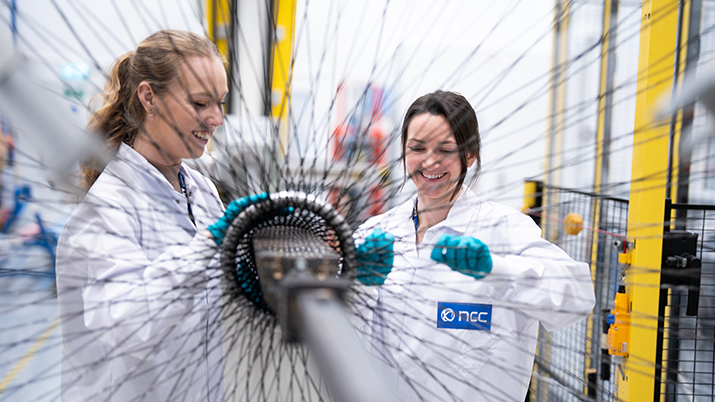
NCC Braider Team

NCC Braider team

Part of the UK’s High Value Manufacturing Catapult and the University of Bristol, NCC is a world-leading innovation organisation that transforms cutting-edge research and technology into industrial impact.

Bridging the gap between research and industry, NCC supports 300 businesses annually, enhances around 50 products and services, creates and sustains 800 jobs, and generates £59m in direct GVA. It brings together over 400 engineers, over 1,400 learners, over 30 graduates and apprentices and 14 years of manufacturing data at the £300m innovation facility, enabling businesses to de-risk and validate technologies from concept development to end-of-life solutions. In July 2025, it powered up Isambard-AI, the UK’s most powerful supercomputer, developed in collaboration with the University of Bristol.

NCC works with sectors from aerospace to energy, pushing technological boundaries while supporting companies to develop the skills their future workforce will need.

Advanced Research Engineer Dr Konstantina Kanari, an alumna of the Bristol Composites Institute, develops advanced material technologies for aerospace and space. She has contributed to the European Space Agency’s Harmonisation Technical Dossier on Composite Materials, supporting a space economy projected to grow from £270bn in 2019 to £490bn by 2030. As space exploration advances, harmonising advanced materials is key to enabling the UK’s role in the global space sector.

Introduction
Clean energy industries

Industrial strategy

  • Introduction
  • Supporting evidence
  • Advanced manufacturing
  • Clean energy industries
  • Creative industries
  • Defence
  • Digital and technologies
  • Financial services
  • Life sciences
  • Professional and business services

Share

  • Tweet this
  • Share linkedin
  • Share on Bluesky

Get monthly updates of our work, events, and higher education news

Subscribe
Back to top
Home

Woburn House, 20 Tavistock Square,
London, WC1H 9HQ
-
+44(0)20 7419 4111
[email protected]

  • About us
    • Introducing UUK
    • Our members
    • Careers
    • Our history
    • People
    • Governance, annual reports and accounts
    • Who we work with
    • Our home: Woburn House
  • Topics
    • Teaching, learning and quality
    • Funding, finance and operations
    • Impact of universities
    • Research and innovation
    • Health and wellbeing
    • Equality, diversity and inclusion
    • Students
    • Climate and sustainability
    • International
  • What we do
    • Policy and research
    • Supporting our members
    • Creating a voice for our members
    • International
    • Work in parliament
  • Latest
    • News
    • Events
    • Insights and analysis
    • Newsletter
    • Podcasts
    • Publications
  • Contact us
  • Privacy notice
  • Modern Slavery Statement
  • Cookies
  • Accessibility

© Copyright Universities UK

Universities UK a charity registered in England and Wales (1001127) and Scotland (SC052497). A company limited by guarantee and registered in England and Wales Company No. 2517018.
Registered Office: Woburn House, 20 Tavistock Square, London, WC1H 9HQ.

  • Follow us on Instagram
  • Follow us on Twitter
  • Follow us on LinkedIn
  • Subscribe on Bluesky

Site by Effusion